
Masonry Block Insulation in Elk Grove Village & Chicagoland
Chicagoland's Masonry Block Insulation Specialists
Concrete block construction is common throughout Chicagoland — in commercial warehouses, industrial facilities, schools, churches, municipal buildings, and older residential properties across Cook County, DuPage County, and the surrounding area. While concrete block is durable and cost-effective to build with, it is a poor thermal performer on its own. The hollow cores within concrete masonry units provide almost no insulation value, making uninsulated block buildings expensive to heat and cool in our climate.
Innovative Insulation Solutions specializes in foam-in-place masonry block insulation — a proven system that fills those hollow cores completely, transforming ordinary concrete block walls into high-performance thermal barriers. It is one of our most technically specialized services, and it has earned us national recognition. We have won four SPFA National Awards for Excellence, including recognition specifically for our masonry and specialty insulation work.
If you own or manage a concrete block building anywhere in Chicagoland, Southern Wisconsin, or Northwest Indiana, this page will tell you everything you need to know.
Request a Free Estimate
Contact Us
We will get back to you as soon as possible.
Please try again later.
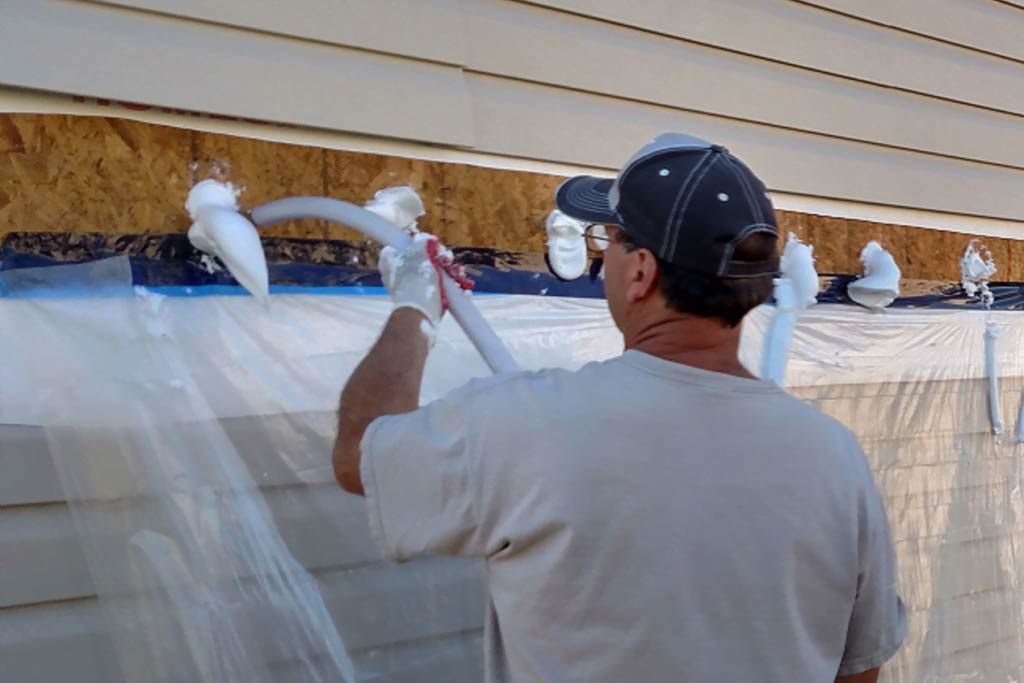
What Is Foam-In-Place Masonry Block Insulation?
Foam-in-place masonry block insulation is exactly what the name suggests. A thermal foam insulation material is injected under mild pressure directly into the hollow cores of concrete masonry units, precast hollow core panels, and cavity walls. The foam fills each core completely, leaving no voids, and hardens in place to create a permanent, continuous thermal barrier within the wall assembly.
The process is straightforward. Small holes are drilled at intervals along the top or side of the block wall, the foam is injected through a hose until each core is completely filled, and the drill holes are patched and finished. The result is a wall that looks identical from the outside but performs dramatically better from an energy standpoint.
This method delivers higher R-values than vermiculite fill or rigid board inserts, is faster and less costly to install than most alternative approaches, and can be applied to both new construction and existing buildings without requiring demolition or major renovation.
Why Masonry Block Insulation Matters in Chicagoland's Climate
Chicago sits in IECC Climate Zone 5. Uninsulated concrete block walls in our climate are a significant liability. In winter, heat moves rapidly through uninsulated block walls, driving up heating costs and creating cold interior wall surfaces that lead to condensation and moisture problems. In summer, block walls absorb solar heat and radiate it into the building, forcing air conditioning systems to work harder and longer.
Concrete block construction is especially prevalent in the industrial corridors along I-90, I-290, and I-294 that run through Elk Grove Village, Bensenville, Franklin Park, Schaumburg, and across the northwest suburbs. Many of these buildings were constructed in the 1960s through 1980s with little or no attention paid to thermal performance. Today those same buildings are dealing with high energy costs, temperature control problems, and occupant comfort issues that foam-in-place masonry insulation can solve cost-effectively.
Retrofitting existing block buildings with foam-in-place insulation is one of the most efficient and least disruptive energy upgrades available for commercial and industrial properties in Chicagoland.
Where Masonry Block Insulation Is Used
Foam-in-place masonry block insulation is appropriate for a wide range of building types throughout the Chicago metro area.
Commercial & Industrial Buildings
Warehouses, manufacturing facilities, distribution centers, and flex industrial spaces throughout Chicagoland's northwest corridor are prime candidates. Many of these properties operate with thin margins on energy costs, and properly insulated block walls deliver measurable reductions in heating and cooling expenses.
Municipal & Institutional Buildings
Schools, fire stations, municipal maintenance facilities, and churches built with concrete block construction across Cook and DuPage County benefit significantly from foam-in-place insulation. These buildings often operate on fixed budgets where energy savings have a direct impact on available resources.
Residential Block Construction
Older homes and multi-family buildings in Chicago and the surrounding communities built with concrete block construction can also be retrofitted with foam-in-place insulation. This is particularly relevant for older residential buildings in Chicago's neighborhoods and inner-ring suburbs.
New Construction
Foam-in-place masonry insulation is equally effective in new construction. Specifying it at the time of build is the most cost-effective approach, and Innovative Insulation Solutions works directly with architects, general contractors, and developers throughout Chicagoland on new commercial and industrial projects.
Thermco Drilling Position
Thermco Insulating
Thermco Patching
Benefits of Masonry Block Insulation for Chicagoland Buildings
Dramatically improved thermal performance
Filling hollow block cores completely eliminates the thermal bridging and heat loss that make uninsulated block buildings expensive to operate in our climate.
Improved acoustical performance
In addition to thermal benefits, foam-filled block walls significantly reduce sound transmission — a real benefit for facilities located near highways, rail lines, or other noise sources throughout the Chicago area.
Cost-effective retrofit solution
Compared to adding exterior insulation cladding or interior stud walls with batts, foam-in-place injection is far less expensive and requires no changes to the building's footprint or interior layout.
Higher R-value than alternatives
Foam-in-place insulation delivers better R-value per dollar than vermiculite fill, rigid board inserts, or other retrofit solutions commonly used in block walls.
Minimal disruption to operations
The drilling and injection process is fast and clean. Most commercial projects can be completed without shutting down building operations.
Effective moisture control
Filled block cores are no longer open pathways for moisture and air infiltration, reducing condensation issues on interior wall surfaces.
Permanent installation
Once injected and cured, the foam is a permanent part of the wall assembly. It will not settle, compress, or degrade over time.
What Our Customers Say
Frequently Asked Questions About Masonry Block Insulation in Chicagoland
How is the foam injected into the block walls without damaging the building?
Small holes are drilled at precise intervals along the mortar joints or block face, sized to accept the injection nozzle. The foam is pumped in under mild pressure until each core is completely filled. The drill holes are then patched with mortar or a color-matched filler to blend with the existing wall. The process is clean, controlled, and leaves the wall looking virtually unchanged.
What R-value does foam-in-place masonry block insulation achieve?
The R-value depends on the thickness of the block being filled. A standard 8-inch concrete masonry unit has cores that, when completely filled with foam insulation, deliver a meaningful improvement over an unfilled block wall. Foam fill provides higher insulation value than vermiculite or rigid inserts and completely eliminates the air infiltration through hollow cores that accounts for a significant portion of heat loss in block buildings.
Can this be done on an existing occupied building?
Yes. That is one of the primary advantages of this system. The injection process is performed from the exterior in most cases and does not require vacating the building or disrupting interior operations. This makes it an ideal retrofit solution for occupied commercial, industrial, and institutional buildings throughout Chicagoland.
How long does a masonry block insulation project take?
Project timelines depend on the size of the building and the number of wall surfaces being treated. Innovative Insulation Solutions has completed projects ranging from small commercial buildings to large industrial facilities across the Chicago metro area. We will provide a clear timeline as part of your free estimate.
Is masonry block insulation available for residential buildings in Chicago?
Yes. Older homes and multi-family buildings constructed with concrete block, as well as properties with block foundation walls, can all be retrofitted with foam-in-place insulation. It is a particularly effective solution for older Chicago-area residential and mixed-use buildings where adding insulation in other ways would be cost-prohibitive.
Do I need to leave my home during spray foam installation?
For most applications, we recommend that occupants and pets leave the property during installation and for approximately 24 hours afterward while the foam fully cures. Our crew will give you specific guidance based on your project size and the areas being insulated. We work efficiently and keep disruption to your schedule to a minimum.
Request a Free Estimate
Contact Us
We will get back to you as soon as possible.
Please try again later.